
Childhood Fascination
As a child, when I read about Alexander and his quest to rule the world, I realized that he had reached my nook of the world in the Western Himalayas before his soldiers refused to go any further and he had to turn back. Some of his soldiers decided not to go back and instead build a new life in these new lands. I fantasized about being a descendent of a Greek soldier who stayed back in the mountains.
This fantasy was based on a deep desire to be different. As I grew up, this desire found expression in my actions and became less about my identity. When I first read about the Proto-Indo-European language and the steppe ancestry of the Indo-Aryans, this fascination was reignited. At first, it remained about discovering my roots but as I’ve gotten deeper into philosophy, it has evolved into a quest to understand the deep questions of meaning, identity, the modern human world and the systems we used to get here.
Proto-Indo-Europeans
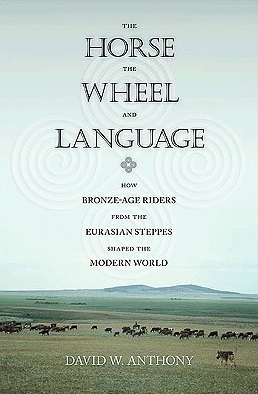
The Horse, The Wheel & Language: How Bronze-Age Riders from the Eurasian Steppes Shaped the Modern World is a wonderful book by the anthropologist, David W. Anthony that I finished reading recently in pursuit of my quest. It is about the origin of the Proto-Indo-European (PIE) language and peoples in the Pontic-Caspian Steppes more than 6000 years ago!
A quick summary for those who don’t know: the PIE language family contains a ton of languages that cover a massive geographical area. From Icelandic and Irish on the North-Western edge to Bengali and Sinhalese to the South-Eastern edge. It contains extinct languages such as Anatolian and Tocharian to old languages still alive such as Latin and Sanskrit. English, German, Italian, French, Spanish, Russian, Armenian, Greek, Persian and Hindi all are daughters of PIE.
The theory developed in this book is now well accepted and supported by genetic analysis. The steppe hunter gatherers were the first to domesticate the horse, and first to build high speed war chariots. These two innovations helped them spread to most of Western and Central Eurasia, and with their migrations, they spread the PIE language family.
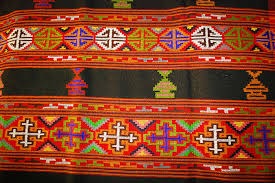
The Indo-Iranian migrants came from the Sintashta and Andronovo cultures. As soon as I saw the stepped pyramid patterns of Andronovo pottery, I knew I had found my heritage. These were the same patterns that are still used in the traditional folk textiles of my home town.

Even though the book is fairly academic and sometimes reading about every item in every grave can get a bit boring, there is enough in there to keep a lay reader interested, especially if you’re fascinated by PIE. Here are a few interesting things I learned from reading this book, in no particular order.
Discovery of Metallurgy
I had always wondered about how humans discovered metallurgy. It doesn’t seem like something that can be discovered by accident—but that’s most probably how it happened.
Before I read this book, I had never given a thought to when humans began making pottery. Archeological digs always contain pottery shards but I just never realized that stone-age humans were also doing advanced pottery.
They made kilns to achieve higher temperatures. They knew about tempering by adding sand or ground up sea shells to prevent cracking. They even knew how to control the color of the clay by controlling the amount of oxygen in the kiln. For example, a black finish was achieved by firing in a low oxygen environment. They also painted, scored and added many decorative elements to their pottery.
This aesthetic need to make pottery that is unique and beautiful, led them to look for different colored soils to make pottery. Of course, bright colors means minerals. Firing clay containing minerals in higher temperature kilns would have produced slag and metal beads. From there, it was just a matter of curiosity and experimentation till they figured out metallurgy.
This is a powerful example of how beauty and curiosity—not just utility—drive innovation. The human mind is wired to explore and transform its environment.
Cooperation Over Conflict
Even before the PIE language developed in the Pontic-Caspian Steppes, animals such as cows, sheep, goats and pigs had already been domesticated and farmer-herders had spread into Europe from the fertile crescent. At the western edge of the steppes, the farmer-herders were in contact with the hunter-gatherers.
Based on the colonial narrative of civilized farmers vs barbarian tribes, you’d think that these two peoples with vastly different lifestyles would always be in conflict with each other, but this narrative is outdated. Steppe hunters took thousands of years to warm up to the farmer-herder lifestyle but they were still trading with them all along.
I can imagine how the farmers would have considered the hunters primitive and the hunters would have thought of the farmers as weird for wanting to live with, and look after, their animals. Despite this, cooperation was the norm—not conflict. Mutually beneficial trade, exchange of technological and cultural innovations and even intermarriage were common.
The hunter gatherers first started acquiring sheep and cattle because they wanted to emulate the grand feasts thrown by the farmers during funerals, and (possibly) religious festivals. In such feasts, lots of animals were sacrificed to please the gods and feed the guests. The hunter gatherers also wanted to take part in this culture, so they started keeping cattle, although their diet remained mostly game meat and fish.
Cattle became a way to acquire wealth. It probably became a currency for paying bride price. Young men started going out on cattle stealing raids. We can see this legitimized through religious stories about a god stealing cattle from a monster of some kind and giving them to the humans, that have survived in many daughter cultures of PIE.
Cattle stealing raids slowly became more violent and led to revenge raids. By the time other ways of acquiring wealth, such as trade of metals and precious stones, with the cities of Mesopotamia and Indus Valley, became common, war had been normalized and the hunter gatherers had become, horse riding, chariot driving warriors.
What I take from this is that conflict may be visible and dramatic, but cooperation is the evolutionary default that sustains civilization. The transformation of cattle raids to warfare illustrates how systems evolve around incentives and symbols of status. It’s not that violence was inevitable, but that social systems began rewarding certain behaviors.
We must constantly re-structure our ethical and political frameworks in response to changing conditions. I believe a post-nihilistic ethic must begin by acknowledging that humans are naturally inclined toward mutual benefit when systems support it.
The Origin of the Caste System
PIE culture had a tripartite social structure—chiefs/shamans, warriors, and everyone else. This is clearly the origin of the Hindu caste system. These three categories correspond to Brahmin, Kshatriya and Vaishya in Hinduism.
The book made me wonder why this system got ossified only in India. Moreover, how were the fourth category of Shudras and then later the fifth category of Untouchables, who were even below Shudras, created?
This tripartite system helped the PIE culture to spread into Europe by making it possible to assimilate local populations into their culture. It is sad that it turned into a toxic hereditary system in India. I can’t be sure of all the reasons this happened but I’m sure that racism must have been one of the factors.
This is a tragic example of a flexible cultural framework ossifying into a rigid hierarchy. What begins as a way to organize society can harden into injustice when it’s no longer responsive to lived realities. This is why my philosophical approach emphasizes iteration—no ethical system should be treated as final.
Chiefs, Jewelry & Spinsters
The chiefs of the PIE culture wore ostentatious costumes to show off their power and prestige. They had metal and bone plates sewn into their shirts. They also wore a lot of jewelry and walked around carrying copper or bronze clubs to represent their power. It made me smile to imagine them walking around the village, shirts jiggling, jewelry clanging, shaking their metal sticks at people.
Interestingly, these clubs were a form of Indra’s weapon, Vajra, that’s also carried by Zeus, Jupiter and Odin in other daughter cultures of PIE. All of them are versions of the original PIE god *Dyḗws Ph₂tḗr or Sky Father.
The jewelry of the Andronovo culture also looks a lot like the jewelry I’ve seen old ladies wear during marriages and festivals in my region. It evokes immense awe in me to think that these patterns in textile and jewelry have been around for close to 4000 years.
If you visit the mountain villages in my state, you’ll still find old women wearing these textiles and jewelry and using a wooden spindle to weave threads out of wool as they walk around or sit in the sun to gossip (literally spinning yarns) with their neighbors. These spindles and this way of making yarn is even older than PIE.
A British comedian once joked that he’d never want to be born in any other time period because life was so miserable before modern science. But this kind of modernist superiority overlooks the resilience and wisdom embedded in ancient, self-sufficient cultures.
If there was a civilizational collapse, the doom day preppers might survive for a while till their supplies last, but it will be these primitive self-sufficient cultures, like in the mountain villages of the Himalayas, that will have the last laugh. Their way of doing things have been tested for thousands of years, while our modern way has only been around for a couple of centuries and is already proving to be unsustainable.
This is why I think philosophers should consider how humans have lived all around the world in different time periods and all kinds of cultures and use that to figure out how we can do the same.
In Closing
Looking back, my fascination with PIE wasn’t just about language or ancestry—it was the beginning of a lifelong curiosity about human evolution: not just biological, but cultural, ethical, and philosophical. As I now work on developing a post-nihilistic philosophy grounded in science, reason, and history, I find myself constantly returning to the past—not for nostalgia or myth, but to understand the raw materials of who we are.
This post might seem like an exploration of Bronze Age horse-riding nomads, but to me, it’s also about the foundations of meaning. To understand how to build a better future, we have to understand the deep codes we’ve inherited—and then learn how to update them.
Cover Photo by Charlotte Venema on Unsplash
 Rudya Aditya
Leave a comment