

Today I woke up at dawn and went outside in the garden where I was greeted by the cacophony of hundreds of sparrows screaming and shouting and fighting with each other in the lemon trees. They were so busy fighting that they didn’t pay me any heed, even as I stood right next to the tree, trying to understand what they were fighting over. Then I realized that they were fighting over property. Every morning, we feed the birds. There’s a birdbath that’s always full of water. We’ve built them a few nesting boxes. And there’s a ton of trees and bushes to live in. Even though we live in a region full of trees and bushes and fields, nobody else here provides such a good place to live for the birds. Our trees come with free breakfast and a swimming pool! And the sparrows were fighting over it viciously. I couldn’t help thinking that if they had access to guns and bombs and tanks and F-16s, they would use them.
The Nature of Evil
Which made me think about the nature of evil. Animals fight and kill each other all the time but we don’t think of them as evil. If they started using weapons and doing it in bulk, then we might think of them as evil. Is that all evil is? Just natural instincts taken to the extreme through technology?
Technology alone isn’t enough. If two countries go to war over a genuine reason and fight a fair war, we don’t think of them as evil. War leads to a lot of death and it’s a tragedy, but we don’t think of it as evil in and of itself. Evil starts to emerge when the ‘fairness’ goes away. If you and me have a disagreement and we decide to fight it out, that’s not evil. If I bring a knife to the fight, it’s not fair, but it’s still not evil. But if instead of fighting you, I kidnap your child or hurt someone you love or get you fired by lying to your boss, then we starting thinking of it as evil. It’s a complicated issue; the level of unfairness, the ratio of what I do to you versus what you do to me, the viciousness of my attack etc. all play a part in whether or not it’s considered evil. But even though it’s complicated, it’s also fairly intuitive. We can tell when someone is being violent but fair and when someone is being evil.
I remember seeing a still of a video recently that went viral last year. It was after the tragic October 7th attack by Hamas on Israel. This was when the IDF started bombing Gaza. A group of young Israelis decided to have a night picnic on a hill from where they could watch and cheer for the bombs falling on the Palestinians. In the picture, these were young and beautiful men and women, laughing and being genuinely happy, while they knew that at least some innocent women and children were dying nearby.
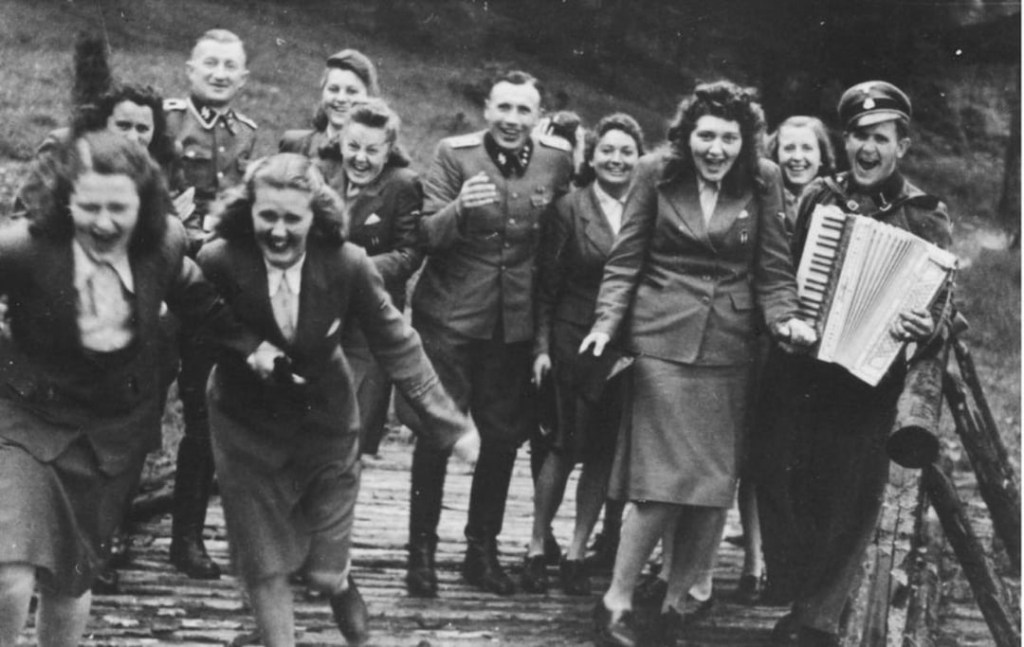
This reminded me of another picture I had seen long ago of Nazi concentration camp guards on their day off, going for a picnic. Once again, I saw young and beautiful men and women in a moment of genuine happiness and joy. They had certainly been torturing and killing innocent people all week.
Even though these two pictures were just images of some healthy and happy young people, they represent evil when you know the context. Killing innocents, with or without weapons and technology, is evil. Killing innocents and being happy about it is definitely evil.
How can people reach a point of such brainwashing that they can live a normal life and be happy while they are torturing and killing innocents, including little children? I saw a video of an orthodox Jew from America who was recalling his visit to Jerusalem a few years ago. There was a Palestinian child who had cut his hand and was bleeding. He tried to help the boy and took him to two IDF soldiers who were patrolling the area and asked them if they could help the little boy. The soldiers laughed and told him to not bother because the child was an Arab and that they were like stray dogs. They scared the child and he ran away.
The Nazis had managed to dehumanize the Jews and other non-Aryans to this level as well. The tragic irony is that the Jews were the victims in one scenario and are now the perpetrators of the exact same thing. This kind of dehumanization is achieved through the help of propaganda which is a form of storytelling.
Storytelling
Stories are a kind of tool that only humans use. Scientists have been trying to understand what makes us capable of cooperating with strangers in a way that no other animals are capable of, and stories might be one of the main tools that facilitates this behavior. Through storytelling, we can build shared systems of belief which create a kind of tribe that is much larger than traditional tribes which were based on kinship and genetics.
As a tool, storytelling is neutral. It has allowed us to build our entire civilization. But it can be used for negative purposes as well. This is why I like nihilism and I’m trying to redefine it in a way that can eliminate the stigma associated with it.
It seems to me that philosophers, in their search for truth, keep coming to the bottomless gorge of nihilism. They peer over the edge and see only darkness below and say, “nope, that can’t be the way.” They turn around and some try to go back while others try to find a different path to the side; something that allows us to get back to meaning and away from nihilism.
Nihilism
Don’t get me wrong, faith, purpose, meaning and stories are all great tools that we’ve used to get so far. But they are not without their issues. I think humanity will eventually go beyond them. We’ll have to enter the gorge of nihilism and I think that we’ll find that it is not bottomless and it doesn’t lead to hell. Once on the other side, humanity will look back at the past and say, “Wow, humans used to be so barbaric.” We’ll still be using some of these tools in various ways but with an abstract understanding that these are just tools, not something to die or kill for.
Humans have always followed this trend. We start by doing the thing, without having any idea about what it is and how it works. Then we start telling stories about it. Eventually we get to a point where we can understand it abstractly and we don’ t have to depend on faith anymore to use it.
Sacrifice
For example, the idea of sacrifice. We started by doing human sacrifice. Then we moved on to animal sacrifice. We told stories about why it is good to do sacrifice. We have to please the gods if we want our future to be good. Now we understand abstractly that when a species becomes intelligent enough to comprehend time and that a future will exist where you will have to survive, the idea of sacrificing today to ensure tomorrow becomes important.
This process happens because humans use the emergent intelligence of humanity to figure things out first. Through evolution we do things that help with survival even if no human was intelligent enough to come up with it in abstract terms. Those who didn’t learn the importance of sacrifice, didn’t survive. We build this hidden knowledge into our stories and rituals so that future generations keep doing it. Those who don’t do it, don’t survive. But once we understand the abstract idea of sacrifice, we don’t need the stories and rituals anymore. We can teach children the importance of sacrifice as applied to delaying gratification and saving for the future, without the rituals and stories about sacrifice.
This process is going to happen for meaning and purpose and stories as well. Right now we’re in the middle of this process happening. Philosophers have to be the scouts in this process and stop being scared of nihilism. I think it is important because as a species develops its technologies, it becomes dangerous to still have archaic faith-based systems to organize itself. Emergent intelligence of evolution will ensure that either we learn to move beyond meaning and learn to cooperate with each other simply because it’s mutually beneficial and because we abstractly understand that helping every human being maximize their potential just helps to ensure the success of all of our genes; or we’ll be one of those who didn’t survive. Either way, eventually, there will be no humans who torture and kill innocent children and then sing happy songs about it.
 Rudya Aditya
Leave a comment